Imagine being the most qualified candidate for an executive role or board seat, yet you’re invisible? According to CapitalOne Research, 57% of employers are less likely to interview candidates they can’t find online.
In tech, your digital presence isn’t optional; it’s your first interview.
I’m developing my presentation on this topic for the WomenTech Network Conference in May. I’d like to share my progress by highlighting the Visibility Stack principles that I teach my tech exec clients to capture the attention of recruiters. I’ll begin with what it takes to establish a searchable identity for career growth.
Visibility Stack
I’m always telling my clients to think like an executive recruiter. Your professional brand is what shows up not only in interview phone screens but also on the worldwide web.
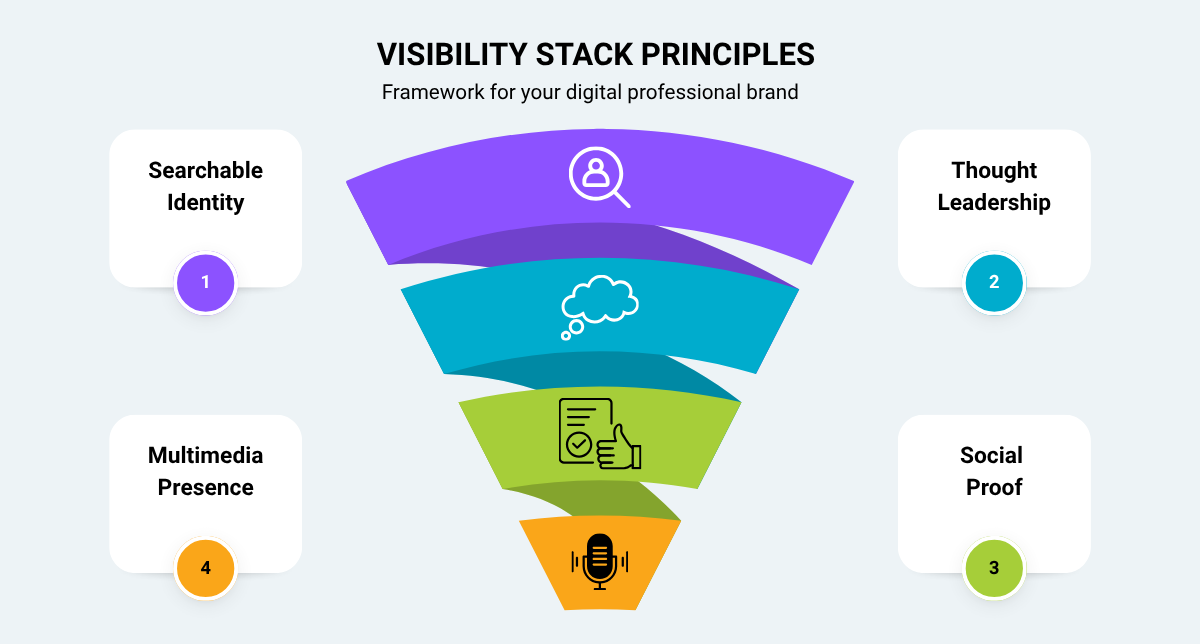
The Visibility Stack principles I developed for professional branding are 4 layers. The basic layer 1 level is whether you show up online. Layer 2 builds upon that, highlighting your professional expertise in print and multimedia. Layer 3 builds on that with your networking and recognition by others as a strategic advisor and influencer. Layer 4 is your audio-visual presence within the professional environment.
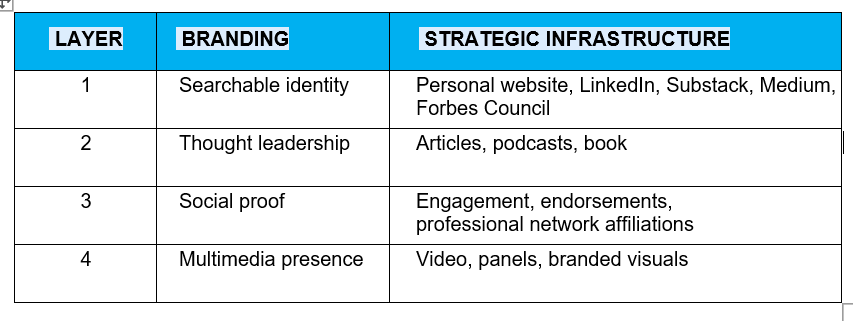
Layer 1 Searchable Identity
Today, I’m going to focus on the first layer. There are two aspects to how your professional brand appears online to a recruiter: (1) where you appear and (2) how you appear digitally.
Where do you appear?
How searchable are you? Go ahead and Google or use ChatGPT to conduct a social media audit yourself. I wrote an article about this last year as part of my own social media audit. My results detail my LinkedIn profile, my consulting website www.resumetech.guru, Instagram, The Authors Guild, and photos sourced from those particular websites, as shown below.
Until 7 years ago, when I started my career consulting business, I didn’t have an online presence except for LinkedIn, which I joined almost 20 years ago. If I can cultivate a professional brand pivot from being a Fortune 500 marketing and sales executive to an independent consultant without hiring a marketing consultant, then you can too. More on that in a minute.
How do you appear?
It’s one thing to have an online presence; the question is, what’s your professional brand conveying to an executive recruiter? With respect not only to myself but also to my valued clients, I’ve made a concerted effort not to post polarizing or negative content, including posts, comments, or videos. It’s certainly your right to have an opinion, but there’s a potential risk to disconnecting with an employer.
Before setting up an initial 1:1 call with a potential client, I Google them to understand their career journey and identify any blind spots. Typically, their LinkedIn profile developed cobwebs, and they joined Twitter/X on the initial FOMO, but their tweets are from 2006 and sometimes lean toward the negative zone.
To be considered an executive thought leader, it stands to reason that there should be expressed thoughts in 2026 on AI, automation, leadership, and customer satisfaction.
Optimization Ideas
There are several options for optimizing your professional brand, including removing unprofessional content and/or increasing your positive content.
Speaking of unprofessional content, I had an enlightening discussion with a security executive regarding YouTube videos from a conference he participated in years ago. He and several security professionals had established an annual conference, and in his younger years, he hadn’t learned the lesson about professional language: sometimes it’s best not to use curse words that will live on in digital perpetuity.
So he hired a fixer. Since the YouTubes didn’t violate their posting policy, his best strategy was to bury the video through search-engine suppression. The goal of the fixer’s assignment was to fill the first page of a Google search with positive content; in turn, this pushes negative content to page 2 or beyond, which is rarely seen. Unless, of course, you’re someone in the public eye, as are executives of Wall Street-traded companies, and you’re being vetted for a new role or board seat.
It’s highly recommended to delete digital content shared via videos, posts, comments, old usernames, photos, and bios that no longer fit your professional brand.
Options to control your online reputation include:
- Contact the website administrators to exercise your “right to be forgotten or erasure” to delete personal information; this right is established in Europe, Japan, Russia, and California.
- Change your personal accounts, such as Instagram and Facebook, to private mode or delete them altogether.
- Hire a consultant to remove or suppress damaging content such as old lawsuits, negative press, defamatory posts, or harmful forum content.
When it comes to increasing your positive online content, one of the simplest ways to turn up is to actively engage through your LinkedIn profile. It’s table stakes to not only have a LinkedIn profile, but it’s equally important to optimize it for an executive search firm and recruiter to see compelling details for why you’re a prime candidate for a board seat or C-suite role.
I teased one of my former colleagues about being in the witness protection program. Initially, it was because his LinkedIn profile photo featured an eagle on a buoy, not his smiling face. And then, to top it off, in frustration with LinkedIn, he cancelled his account. Poof, this is an example of how not to have a Layer 1 Searchable Identity. I’m happy to report that my colleague resurfaced online with a new LinkedIn profile.
How-to for Strategic Infrastructure
I became bored after an early corporate retirement 10 years ago. With several years of pro bono career consulting at Dress for Success in Austin and Seattle, I made a pivot by returning to school to become a certified executive career coach.
My challenge for Layer 1 was to develop my new professional identity to attract clients. I had to reinvent myself to appeal to tech executive clients seeking their next big-impact roles.
Tracing back to my corporate branding consulting days, I created a 2-page corporate branding guideline for my company, Resumé Tech Guru. My guidelines outline the following, which you can clone and own for your professional brand with your unique differentiators.
Professional Brand
- Authority: career strategist for tech executives backed by quantifiable experience, Fortune 200 pedigree, and extensive coaching history
- Boldness: authoritative voice in tech career storytelling using the Visibility Stack framework and published writing for subject matter authority
- Guidance: relatable and authentic guide sharing my personal journey from corporate success, retirement, and entrepreneurial reinvention
- Thought-leadership: confident, modern, and slightly edgy communicator with a writing tone that stands out as honest and anchored in real executive experiences
- Authenticity: brand built on outcomes, transformation, and strategic clarity to prioritize measurable results and executive-level momentum
Bio
- Monique Montanino is a former Fortune 200 tech marketing and sales executive who pivoted into a second act as a career strategist for technology leaders. After nearly two decades in high-stakes roles, complete with the proverbial “golden handcuffs” of stock options and bonuses, she retired early and founded Resumé Tech Guru, where she now helps executives land their next big-impact roles with Visibility Stack principles.
Fonts & Colors
- Website theme fonts are Raleway and Roboto; my logo font is Exo.
- Colors for website, presentations, speaking engagement attire, and blog post images are green (#A6CE39), blue (#00ACCD), and orange (#FAA619).
Google Ads Keywords
- Resume writers, professional resume, resume builders, professional resume service
Next, I moved on to establishing my digital presence.
The no-brainer was to develop a business consulting website. With my love of learning new things, I spent a month researching domain names, web hosting, and creative themes. I created and launched my website www.resumetech.guru seven years ago. To build credibility, I asked clients for recommendations, which were added to the site.
Then I hopped over to my LinkedIn profile, applied my corporate brand guidelines, and started posting full-length articles weekly to educate tech executives on how to navigate the career-pivot journey. To be fair, I white-knuckled the first article I posted on LinkedIn because I jumped into a new arena for voicing my thoughts online and wasn’t sure how it would land. It worked out, so yours can do the same or better!
To add to that, I signed up for a LinkedIn Premium Business annual subscription at the time for $635, focused on receiving email leads from executives seeking LinkedIn and resume optimization.
Voila, my Layer 1 infrastructure was established, which helped me generate 5 figures in consulting fees in half a year back in 2020. Not a ton of revenue, but a healthy jump-off point.
The Point
Getting back to why your online brand is blocking career growth, you need to first establish a searchable identity. And more to the point of the Visibility Stack principle of Layer 1, when a recruiter Googles you, your likability increases by establishing a positive digital presence with LinkedIn or your own website.
Next time, I’ll share Layer 2 tips and tricks about conveying your thought leadership.